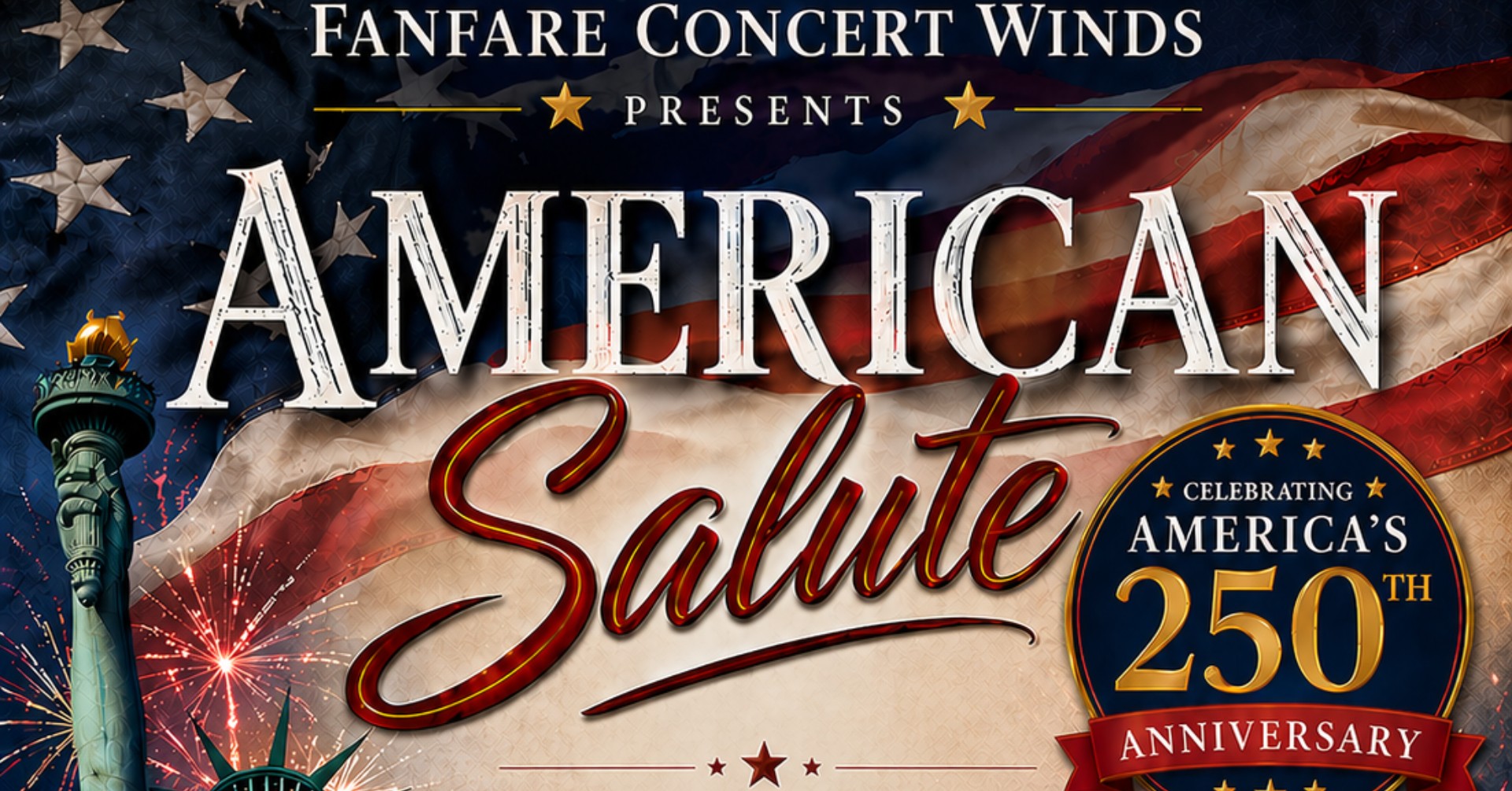
Concert Program
-
COLUMBIA – Randall D. Standridge
-
FANTASY ON “YANKEE DOODLE” – Mark Williams
-
MOLLY PITCHER – Steve Dunn
-
MT. VERNON REVERIE – Larry MacTaggart
-
AMERICAN SALUTE – Morton Gould
-
STEEL DRIVING MAN – Steve Dunn
-
CIVIL WAR FANTASY – Jerry H. Bilik
-
AMERICAN’S WE – Henry Filmore/arr. Robert E. Foster


Fanfare Concert Winds Members
FLUTE/PICCOLO
Helen Bailey
Amy Carrasco
Madeline Davidoff
Nancy Green
Hannah Hyatt
Lee Lafleur
Sarah Liebelt
Katrina Lindquist
Kate O’Leary
Stephanie Padron
Joseph Rose ♫
Kathryn Thorson
OBOE
Veronica Jacob
BASSOON
Molly Bacon
June Hammond
David Menzies *
CLARINET
Brandi Dean
Paige Gale
Brian Hanson
Sharon Henson ♫
George Linakis ♫
Tom Lyons
Anita Smith
Adam Sugarman
Jeanette Sung
ALTO CLARINET
Jose Ortiz
BASS CLARINET
John Horne
ALTO SAXOPHONE
Joni Long
Jaissac Morales *
Rodger Nelson
Javier Quiles *
TENOR SAXOPHONE
Jon Harmon
BARITONE SAXOPHONE
Alli Howard ♫
♫ Denotes Section Leader
* Denotes HCC Student
TRUMPET
John Acosta
John Baker ♫
Lacey Bigler
Cyndi Burchfield
Richard Crawford
Matt King
Terri Molesky
Sherlyn Padron
Roberto Plumey
Chris Shultz
Michael Vail
FRENCH HORN
Philip Booth
Jordan Fraze
Christina Frye
John Green
Jackie Hall ♫
Bradley Harp
Michael Siebenthal *
TROMBONE
Raymond (Ray) Deckert
Michael Henry
Lewis Lopez ♫
Walt Shaffner
John Whitaker
BASS TROMBONE
Lucas Zeller *
EUPHONIUM
Saniyah Abrams *
Rick Hatfield
Cheri Sleeper
TUBA
Douglas Barlar
Daniel Hadden
Leigh Simonton ♫
PERCUSSION
John Bannon
Steve Brown ♫
Manny Francisbarlan *
Sam Koppelman
Dante Morales *
Manny Rosadilla
Jae Xiong
PIANO
Joseph Rose ♫
Conductor Ted M. Hope has served as the conductor of the Fanfare Winds and Hillsborough Community College for the past 10 years. He was affiliated with the Hillsborough County School District for 39 years and retired as the Supervisor of Middle and Secondary Music after 19 years of service in March of 2023. He received his Associates Degree from Hillsborough Community College, Bachelor of Music Education from Florida State University, and his Master of Music Education and Education Specialist from the University of Southern Mississippi. He subsequently taught in the public schools for twenty years as band director at Hillsborough High School (1984-1987) and Bloomingdale High School (1987-2004). He is a member of the Florida Bandmasters Association where he served as chairman and secretary. Mr. Hope’s professional affiliations include Music Educators National Conference, Hillsborough County Secondary Music Council, Phi Mu Alpha Sinfonia, the Bay Area Saxophone Quartet and the Hillsborough Association of School Administrators. Mr. Hope is an active clinician and adjudicator in concert band, jazz ensemble, and marching band.
Program Notes
COLUMBIA – Randall D. Standridge
Columbia is the name of a character that served as the personification of liberty. Typically, depicted as a robed woman with a scepter and other implements. “Lady Columbia” was designed to be a beacon of hope and a symbol of freedom for all.
This piece attempts to take inspiration from that figure and the American frontier. The listener will hear hints of the American West, Aaron Copland, patriotic melodies, barn dances, and a cinematic style all rolled into a driving and rhythmic work that fairly shouts, “Americana.” Mr. Standridge imagined the opening fanfare echoing out across the Great Plains before we journeyed on horseback across the land. The middle segment reflects the beauty of our forests and lakes before returning to its more rustic mode. This piece was commissioned by the Columbia Community Band of Columbia, Missouri, in celebration of their 200th Anniversary of the State of Missouri and the founding of their city.
FANTASY ON “YANKEE DOODLE” – Mark Williams
The song was a pre-Revolutionary War song originally sung by British military officers to mock the disheveled, disorganized colonial “Yankees” with whom they served in the French and Indian War. It was written at Fort Crailo around 1755 by British Army surgeon Richard Shuckburgh while campaigning in Rensselaer, New York. The British troops sang it to mock American soldiers as simpletons who thought that they were stylish simply by sticking a feather in their hats. It was also embraced by American troops, who added verses to it that mocked the British and hailed George Washington. By 1781, “Yankee Doodle” had become a song of national pride among Americans.
According to one account, Shuckburgh wrote the original lyrics after seeing the appearance of colonial troops under Colonel Thomas Fitch, the son of Connecticut Governor Thomas Fitch. According to the Online Etymology Dictionary, “the current version seems to have been written in 1776 by Edward Bangs, a Harvard sophomore who also was a Minuteman.” He wrote a ballad with 15 verses which circulated in Boston and surrounding towns in 1775 or 1776.
MOLLY PITCHER – Steve Dunn
During the American Revolution, cannon crews for the Continental Army often had family members, including wives, that traveled with them. As the legend goes, it was common for these wives to have the critical job of carrying water for the crews and other troops, often earning the nickname of “Molly Pitcher.” There are many stories of occurrences where the husband in the cannon crew was injured or killed during the fighting and the wife stepped in to help with firing the cannon to the end of the battle. (The best-known women connected to these stories are probably Mary Hays at the Battle of Monmouth in 1778 and Margaret Corbin at the defense of Fort Washington in 1776.)
MT. VERNON REVERIE – Larry MacTaggart
Sitting majestically on a hill overlooking the Potomac River, the mansions on the grounds of Mr. Vernon is one of the most recognized icons in American history, George Washington inherited the estate in 1761 and lived there when he could, until his death in 1799.
Mt. Vernon Reverie is a musical tribute to serenity and all-encompassing sense of peace that pervades the grounds of Mt Vernon. A touching lyric theme calls to mind the panoramic view from the east side of the mansion. A fanfare section hails the arrival of General Washington eventually giving way to the restatement of the lyric section and concluding with a serene sunset.
AMERICAN SALUTE – Morton Gould
Originally written for orchestra, American Salute has become a favorite of the concert band repertoire. Using the familiar tune, When Johnny Comes Marching Home as the sole melodic resource, Morton Gould demonstrates his skill in thematic development, creating a brilliant fantasy on a single tune.
Written in 1942 in the early days of World War II, it was composed at the request of a government radio program producer who wanted a “salute to America.” The composer insisted that he had no idea that the work was destined to become a classic: “It was years before I knew it was a classic setting. What amazes me is that critics say it is a minor masterpiece, a gem. To me, it was just a setting. I was doing a million of those things.” A million may be an exaggeration, but not by much. Gould’s schedule in those days was astounding. By his own account he composed and scored American Salute in less than eight hours, starting at 6 p.m. the evening before it was due (with copyists standing by), and finishing at 2 a.m. Although the ink couldn’t have been dry, the score and parts were on the stand in time for rehearsal the next morning and ready for broadcast that evening.
American Salute, written during World War II, is a fine example of both Gould’s sophisticated writing and his instinct for achieving broad appeal. This piece is based on When Johnny Comes Marching Home, originally written during the Civil War by Patrick Gilmore and subsequently securing a strong position within American popular culture. American Salute has become Gould’s most popular work. The composer attended a performance of the piece, given by the United States Military Academy Concert Band, on the last evening of his life.
STEEL DRIVING MAN – Steve Dunn
The story of John Henry is one of America’s most enduring folktales, symbolizing the clash between human labor and emerging industrial machinery. In the 1870s, during the construction of railroad tunnels, African American workers like John Henry were hired as steel-driving men — hammering a steel drill into rock to make holes for explosives.
The Contest
According to legend, John Henry was working on a C&O Railway tunnel when the railroad company introduced a steam-powered rock drill to speed up work. The drill could drill faster than any man, but the company arranged a race to see who could drill the deepest hole in a set time. John Henry, known for his strength and speed, won the race — but as he reached the finish line, his heart gave out, and he died clutching his hammer. The story has been told in blues ballads and work songs, becoming a symbol of perseverance and the limits of human endurance.
CIVIL WAR FANTASY – Jerry H. Bilik
After a brief introduction using the main themes in fragments, we try to picture musically the mood of the United States just before the Civil War. We hear popular tunes of the mid-nineteenth century, Listen to the Mockingbird, Dixieland, and Camptown Races. From the distance comes the sound of drums and the strain of John Brown’s Body, announcing the first signs of the coming conflict. Little whispers of Dixie and The Battle Cry of Freedom become intermingled, and then we hear the brilliant strains fo the South’s rallying song, Maryland, My Maryland (Oh Tannenbaum). This gives way to the Union Hymn, The Battle Cry of Freedom, and suddenly we hear When Johnny Comes Marching Home as young Americans from both North and South were called from their homes to fight one another. Here the music becomes meditative, gradually dying out, as the soldier recalls many songs of his day, weaving through the sentimental melody, Just Before the Battle Mother.
The reverie is soon broken by the thunder of drums as we picture first the Northern armies on the move, Marching Through Georgia, then the Southern troops and The Yellow Rose of Texas. With fragments of their favorite song ringing in their ears, the two armies come closer, the music building in intensity. Finally, in a shattering explosion, the war is on!
The war is fleeting instant in the strain of history, and its noisy tumult soon dies away, giving birth to The Battle Hymn of the Republic. A Republic restored but not proud of its costly victory. Slowly the music builds in grandeur, representing the spiritual hope for a peaceful and prosperous United States of America that eventually becomes a reality, as the immortal words of Abraham Lincoln became a symbol of dedication for all Americans; the “government of the people, by the people, and for the people shall not perish from the Earth.”
AMERICAN’S WE – Henry Filmore/arr. Robert E. Foster
In 1927, Henry Fillmore was the conductor of his own 24-member professional band in Cincinnati. They were performing a very popular series of concerts at the Cincinnati Zoo when they performed a new march that is today considered one of his best. While the march was an interesting success, Henry had difficulty finding a good title. In its first performance he called it The Cincinnati Zoo, and at other times he announced it as Pure Food and Health, the name of one of the sponsoring organizations. Neither of these titles seemed appropriate for publication. He realized that this was one of his finest works and he waited until he had decided on an appropriate title to publish it. When it was published in 1929, it was called Americans We and was simple dedicated “To All of Us.”
In 1927, he created a unique piece of music for his own dog, Mike, a “faithful play hound” who could bark on cue. Fillmore, already known for his marches and band arrangements, decided to write a march dedicated to Mike, calling it “Playfellow”
The dedication read: “To a dog. Our dog, Mike, a faithful play hound.” Fillmore composed the piece so that Mike could perform it himself — he did not mark the published score with the exact barking spots. Instead, when he played it at concerts, he would tell the musicians where to cut off and let the dog’s bark come through.
Mike was not just a pet; he was part of Fillmore’s musical world. He performed with Fillmore’s band on WLW radio broadcasts and even recorded as an “exclusive Columbia Record Artist.: This was unusual at the time — there were few pieces of music written for or dedicated to dogs — and Fillmore filled that gap with Playfellow.
In the Playfellow March, the “dog fight” section is the part where the band’s percussion and brass play a rhythmic, energetic pattern that mimics the sound of a dog’s barking. This section is not a literal fight but a musical representation of the dog’s vocalizations, integrated into the march’s structure.
In 1938, advised by a physician that he had only months to live, Fillmore retired to Miami, Florida. He founded and led the University of Miami’s Band of the Hour, publishing many works for school and community bands and was active in the founding of the Florida Bandmasters Association. He also transformed his family’s music publishing business, The Fillmore Music House, into a major force in band music.
Patrons
The Board of Directors of Fanfare Concert Winds wishes to thank, with great appreciation, the donations made by our band and audience members. This year’s largest donations came from audience members, totaling over $2,000. THANK YOU!!! Total donations were over $3,000.
Every penny of these donations went to purchasing new music for you to enjoy.
If you would like to make a donation, you can find us on PayPal, (Fanfareconcertwinds.org)
Or mail a check to Fanfare Concert Winds, 9465 Forest Hills Pace, Tampa, Florida, 33612.
Thank you in advance for your continued support.
Benefactor
Brown & Brown Insurance
D&L PC Support
Forest Hills
Jerry Krumbholz
Mind’s Eye Presentations, Inc
Gold
Bruce Bursack
Dana Burt
Debora Felton
(in memory of Lee Felton)
Silver
Michael and Patty Bleau
Jim Burge
Friendship Class at Lake Magdalene United Methodist Church
John Harp Realty
Lori Ledbetter
Music Showcase
Rosann Guiggino Garcia
Paul and Nancy Prine
University of Tampa
Vivien Keen
(in memory of Bobbie Keen)
Platinum
John and Mary Ann Acosta
Anonymous
Carollwood Cultural Center
Harp-Hawkins Vacation Homes
Kenneth Schwartz
Joe and Mary Jane Stagi
United Tube
Platinum
Joni Long
Gloria and Rosie Stagi
(in memory of Joe Stagi)
Kathryn Thorson
Dawn White
Bronze
Alli Howard Tampa Realty
Andrew Altman
Ian Crumpton
Jacqueline DeBeer
Debbie Eisenstadt
Mark Frederick
Emily Garrett
Bradley Harp
Tina Hill
Niki Holmes Kantzios
Aaron Kaplan
Kay Kleinhample
Andrew Krupski
Terri & Hank Molesky
Dale A. Roberts
Larry Smith
Sally C. Spencer
Yajaira Suarez
Amy Tramer
Carmel vanHoek
Gregory Vass
John Walker
George Zucker
We now accept donations on our website via PayPal.
https://fanfareconcertwinds.org/sponsor/
Sponsors

Instruments of change
The old phrase “All boats rise with the tide” really applies to the mission of Instruments of Change. Learning to play a musical instrument improves academic performance on many levels. By teaching a child to play a musical instrument, you change their potential for success. Your investment in the children of today sets in motion a series of positive changes that echo throughout our community. Things you can do to help us:
• Please consider donating a new or gently used musical instrument.
• If you can play a few notes, you can begin teaching a child to play.
• Make a financial donation. You can make a difference in our ability to help.
Our Mission: To profoundly impact the lives of disadvantaged children through the gifts of musical instrument donation, instruction and performance.
www.InstrumentsOfChange.com ~ 813-315-9762
About Fanfare Concert Winds
The Fanfare Concert Winds has earned its reputation as the premier hybrid community/college band in Tampa Bay through a combination of exceptional musicianship, community engagement, and a commitment to musical excellence. One key factor is the band’s unique blend of talented musicians, comprising both seasoned community members, current and former music teachers, and dedicated Hillsborough Community college students. This diverse composition brings together individuals with a wide range of musical experiences and backgrounds creating a rich and dynamic ensemble that appeals to a broad audience.
The band’s commitment to musical excellence is evident in its rigorous rehearsal schedule and the pursuit of challenging repertoire. Under the direction of skilled conductors, section leaders, and instructors, Fanfare Concert Winds consistently delivers performances that showcase both technical proficiency and emotional depth. This dedication to artistic achievement not only enhances the musicians’ skills but also elevates the overall musical experience for the audience, contributing to the band’s recognition as one of the best in the Tampa Bay region.
Community engagement and education plays a pivotal role in the Fanfare Concert Winds’ success. The band actively promotes new teacher involvement and educational outreach programs. This action only strengthens the ensemble’s connection with area band directors by “building their resilience”, but also with its audience while promoting a sense of pride and unity among its members. By serving as cultural ambassadors in the Tampa Bay area, the Fanfare Concert Winds has become an integral part of the community, further solidifying its reputation as the top hybrid community/college band in the region.
Fanfare Concert Winds would like to thank Ken Hanks, Chair of Visual and Performing Arts, and Ruthie Nelson, Director of Choral Activities of Hillsborough Community College for their encouragement and support.
Support Fanfare Concert Winds
Fanfare Concert Winds is a “Not for Profit” Organization. That means that all donations to our organization are 100% tax deductible.
Please consider a donation to Fanfare Concert Winds to help defray the cost of music.
Our tax number is 47-49031478.
You can give a check tonight (see Dana or Ted) OR:
You can mail a check to:
Fanfare Concert Winds
9465 Forest Hills Place
Tampa, FL 33612
Thank you for attending tonight’s concert!
VISION
The Fanfare Concert Winds will contribute to the musical culture and community throughout Hillsborough County by providing quality music performance and educational experiences for the young and the young at heart.
MISSION
• To facilitate a venue for music educators, professional and community musicians and Hillsborough Community College students to come together in a professional-level ensemble.
• To supplement the music education of the Hillsborough County Public Schools and Hillsborough Community College through clinics, side-by-side concerts, festivals and scholarships.
• To expose our members and audiences to quality musical literature.